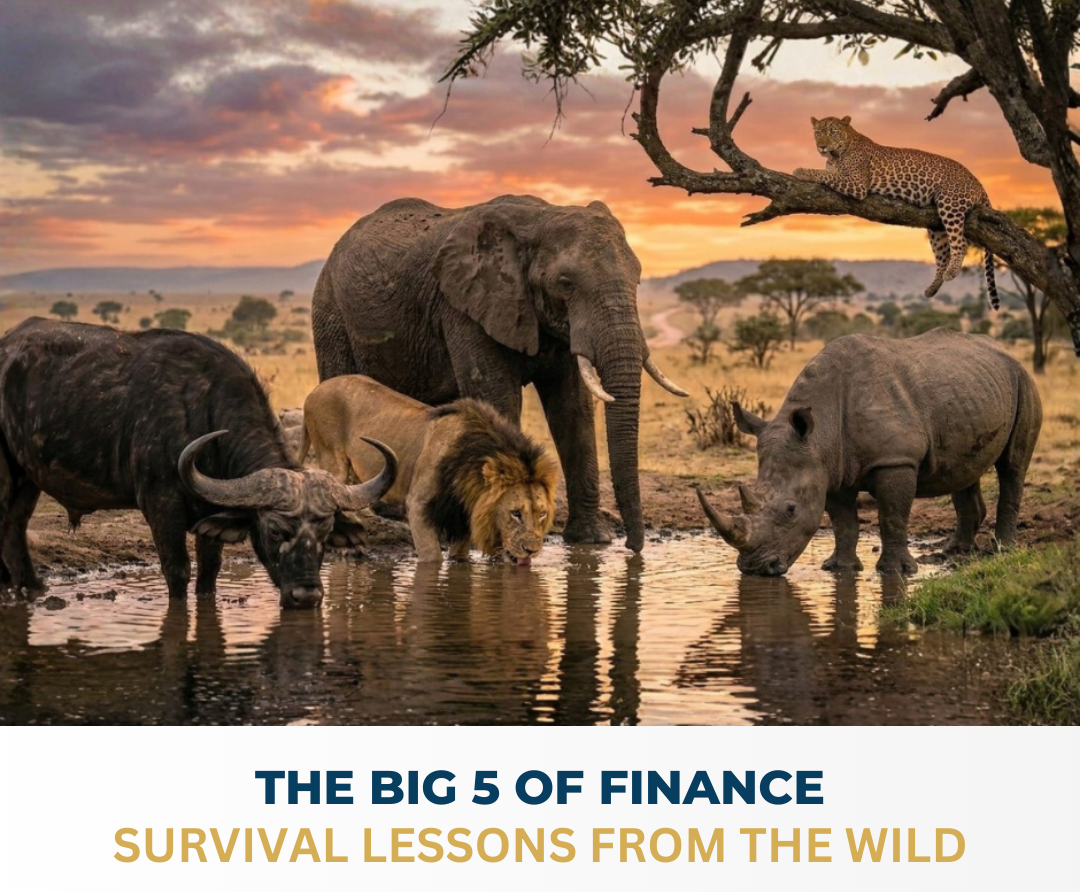
In the wild, survival isn’t about being the loudest; it’s about being the most prepared. For World Wildlife Day 2026, we’re looking at the “Big 5” not as trophies, but as essential behaviours for a resilient business. Whether you are launching your first startup or navigating your fifth year of growth, these five principles are your roadmap to a sustainable legacy.
1. The Lion: The Rule of Capital Preservation
A lion doesn’t hunt every time it sees movement; it conserves energy for the kill that matters. Many SMEs fail because they “hunt” every unvetted marketing trend or allow leakages through poor financial administration and lack of oversight.
- The Lesson: Protect your working capital at all costs.
- Daily Action: Apply the 24-Hour Rule. Hit the pause button for 24 hours and then reassess. If the benefit for your business is still not clear, the answer is “not now”.
2. The Leopard: Master Operational Agility
The leopard thrives because it can climb, swim, and hunt in total darkness. In business, your greatest strength is agility and adaptability.” When overheads are well managed, your business is better positioned to adapt smoothly to market shifts.
- The Lesson: Keep your fixed costs low and your skills diverse.
- Daily Action: Audit your recurring subscriptions monthly. If a tool or service isn’t helping you “climb” higher, cut it to remain light and agile.
3. The Elephant: Long-Memory Accounting
Elephants survive droughts because they remember where the water holes were decades ago. For an SME, “memory” is your data. You cannot scale what you do not measure.
- The Lesson: Historical data aids in predicting your future cash flow.
- Daily Action: Spend 15 minutes every Friday reviewing your Cash Flow Forecast for the next 30 days. Don’t just look at what you spent; look at the “watering holes” (receivables) ahead.
- Pro-Tip: Compare your actuals against your forecast monthly. If you consistently miss the mark, identify the “leak”. Is it late-paying clients or under-budgeted expenses? Awareness is the first step to correction.
4. The Rhino: Defensive Risk Management
The rhino doesn’t wait to be attacked to grow a horn; it is built for defence. Many business owners wait for a crisis, a lost client or a broken machine, before thinking about a “Plan B.”
- The Lesson: Build your “thick skin” while times are good.
- Daily Action: Maintain an Emergency Reserve. Aim to set aside a small percentage of monthly income into a separate account until you have 3–6 months of operating expenses.
- Crucially, this should only be done once you have set aside money due for VAT to SARS. Remember, VAT is not your money, it is collected on behalf of the state and should never form part of your operational cash flow considerations.
5. The Cape Buffalo: The Strength of “Herd” Liquidity
The Buffalo is formidable because of the collective; a lone buffalo is vulnerable, but a herd is an impenetrable wall. In business, your “herd” includes your internal team, suppliers, stakeholders, and customers. No SME is an island, and true resilience comes from the strength of your professional ecosystem.
- The Lesson: Collaborative strength outweighs individual effort.
- Daily Action: Focus on relationship management. Seek out strategic partnerships with other SMEs to share resources or access specialized expertise without the burden of full-time overhead costs.
Why This Matters for Your Growth
At PGCO, we believe that a healthy economy starts with healthy SMEs. These five traits aren’t just metaphors; they are the fundamental DNA of any business that intends to be here ten years from now.
Nature doesn’t reward the biggest; it rewards the most adapted.
The PGCO Team