In 2026, the question is no longer if you should use AI in your finance department, but where the technology ends and leadership begins. While Large Language Models (LLMs) and automated ERPs can generate a Balance Sheet in milliseconds, they lack the one thing that saves companies during volatility: Contextual Intelligence.
The “Data Trap”: When Accuracy Isn’t Enough
AI is a master of the “rear-view mirror.” It looks at historical data to predict future trends. However, business doesn’t happen in a vacuum. A bot can tell you that your overhead is rising by 12% year-on-year, but it cannot account for the necessity for this spend.
A human CFO understands the difference between wasteful spending and strategic investment. AI might flag a high marketing spend as a “risk,” whereas a human strategist sees it as the necessary fuel for a Q4 product launch. Without human oversight, relying solely on AI leads to “Optimization to Death”—where a business becomes so efficient at cutting costs that it loses its ability to innovate.
The PGCO Framework: The A.I.D. Model
To stay competitive, we recommend businesses adopt the A.I.D. Framework—a strategy we use at PGCO to ensure our clients get the best of both worlds.
1. Automate (The Tactical Foundation)
The first step is moving your team away from “Data Entry” and toward “Data Oversight.”
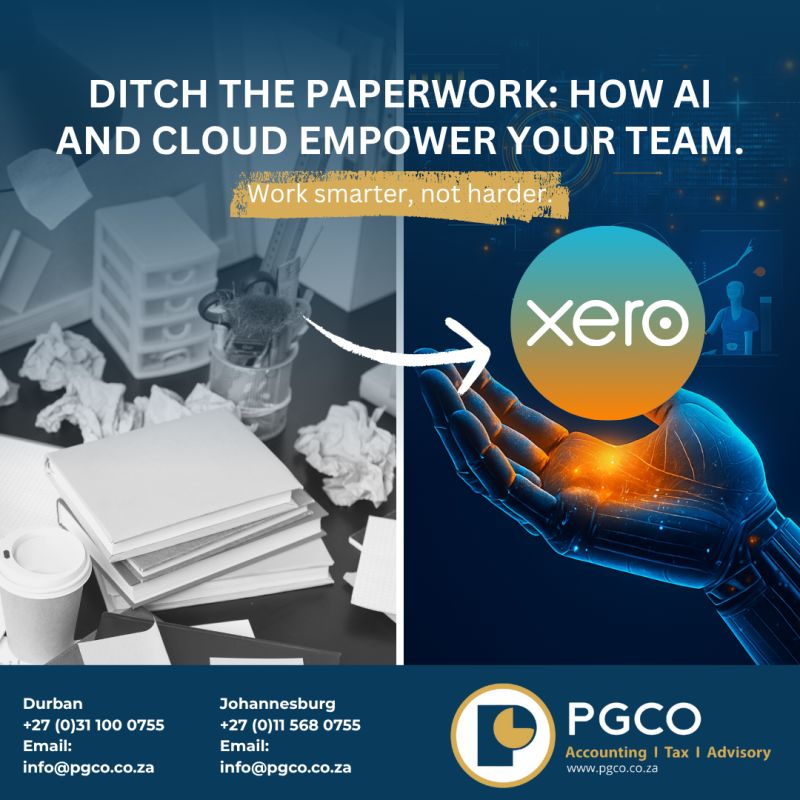
- The Tech: Use AI for automated bank reconciliations, OCR (Optical Character Recognition) for invoice processing, and real-time cash flow tracking.
- The Benefit: This eliminates human error in the most tedious parts of finance.
- Takeaway: If your team is still manually typing data into spreadsheets, you are paying for clerical work when you should be paying for insight.
2. Interpret (The Strategic Bridge)
This is where the human begins to lean on the machine to find the “Story” in the numbers.
- The Process: AI identifies an anomaly (e.g., a sudden shift in customer churn). The human CFO then investigates the external causes—perhaps a competitor’s new campaign or a shift in local logistics.
- The Benefit: You get the speed of a bot to find the “needle in the haystack,” but a human to tell you what the needle means for your bottom line.
- Takeaway: Ask your financial lead to identify the “Anomaly of the Month.” Use AI to find the outlier, then use a human to explain the narrative behind it.
3. Decide (The Executive Apex)
Strategic decisions—like a merger, a major pivot, or a capital raise—require moral and fiscal responsibility.
- The Process: Use AI to run 1,000 “What If” scenarios (Monte Carlo simulations) to see potential outcomes.
- The Human Touch: A human leader chooses the path based on company values, risk appetite, and long-term relationships with stakeholders.
- Takeaway: AI provides the menu of options; the human CFO chooses the meal.
Why Judgment is the New Currency
As AI commoditizes data processing, judgment becomes the most valuable asset in your business. At PGCO, we position ourselves as AI-augmented humans. We don’t fear the bot; we use it to clear the administrative fog so we can focus on:
- Risk Intuition: Recognizing “black swan” events that historical data cannot predict (like sudden regulatory changes or global shifts).
- Interpersonal Leadership: Communicating complex financial health to your board or investors with empathy and clarity.
- Creative Problem Solving: Finding non-linear solutions to cash flow gaps that an algorithm wouldn’t be programmed to suggest.
Future-Proofing Your Business
The goal isn’t to be the most “automated” business; it’s to be the most agile. By using AI to handle the “What,” you empower your leadership to focus on the “So What?” and the “Now What?”
At PGCO, we don’t just provide reports; we provide the roadmap. Because in a world of infinite data, the most valuable thing you can have is a clear direction.
The PGCO Team