How to Master Your February Close and Set the Stage for 2026
As the financial year draws to a close, many small businesses find themselves under the pump when it comes to their financial housekeeping. Too often, business owners leave all their tax administration until the last minute, some even only after SARS’s all too familiar cold clinical ‘tap on the shoulders’ before gathering those missing invoices, receipts, or finance agreements. February may be the shortest month, but if it marks the end of your company’s financial year, then it’s also the month where your numbers speak the loudest. We’re here to ensure they tell a story of success or even one of valiant efforts if it was a more challenging year, but not a horror story.
The financial year-end is more than just the annual reports of money going in and out; it’s not only about last-minute debt settlements, the last push for client collections, or closing off projects. For small businesses, this is a key time to pause, reflect on the past year’s achievements or learning curves, and prepare for the year ahead.
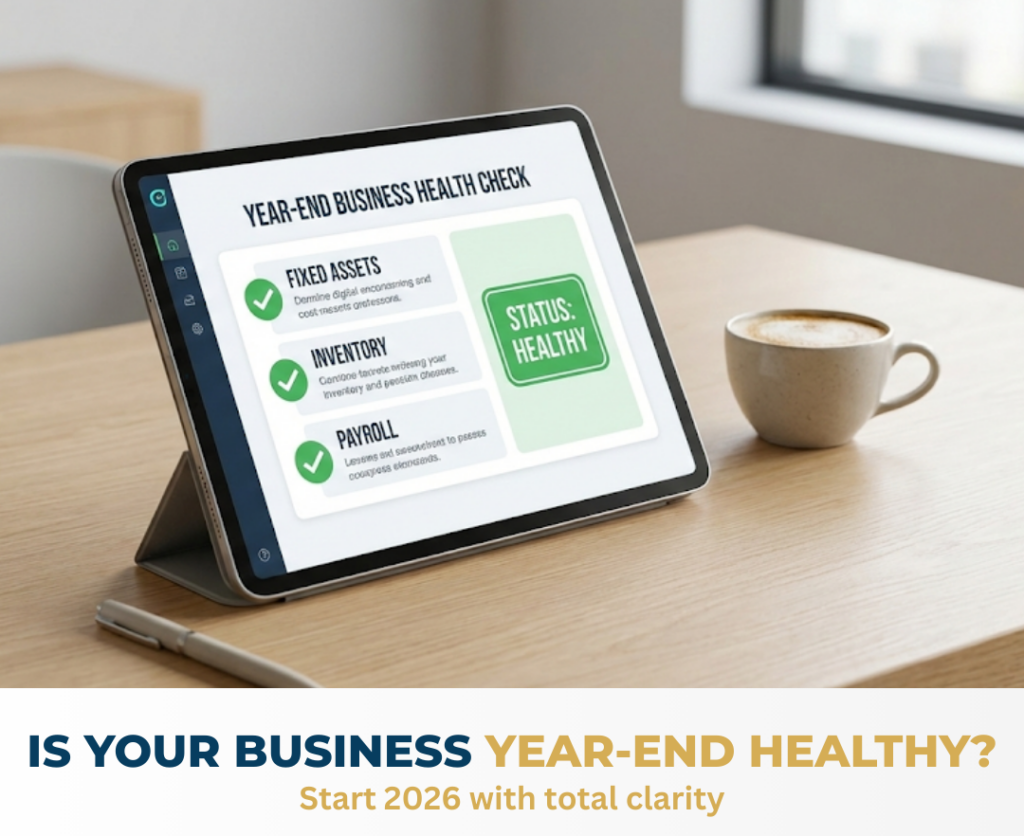
We’ve put together a financial health checklist that every small business should consider before their financial year-end:
1. Reconcile all banking accounts.
The following should ideally be reconciled monthly; however, it is imperative at year-end:
- Bank accounts
- Credit card accounts
- Loan accounts
- Petty cash
This ensures every transaction is recorded and any errors or discrepancies can be resolved timeously. Cloud-based systems allow for seamless reconciliations, and their live dashboards make it easy to identify accounts and reconcile them against the relevant bank statements.
2. Capture All Business Expenses & Organise Supporting Documents.
- Ensure all invoices and receipts are recorded, including often‑missed ones like staff mileage claims, invoices that are physically received in hand, especially in the absence of a cloud application like Dext or Hubdoc that usually assists with digital capture in these instances, and finance agreements that assist in the accurate recording of finance charges and the related liability due.
- Perform basic reasonableness checks on routine accounts, such as monthly subscriptions, rent or utilities, where there should be 12 entries for the year.
3. Verify Trade Receivables (Debtors) & Trade Payables (Creditors)
- Review your outstanding customer invoices, send statements, and follow up with customers to determine whether payment is possible before year-end.
- Write off bad debts where recovery of long outstanding customer invoices is unlikely.
- Review your outstanding supplier payments and reconcile your accounting records to supplier statements. This will ensure outstanding creditor balances at year-end are accurate.
- Tracking payables helps owners understand their company’s liabilities, and accrued expenses
4. Conduct a physical inventory count and review inventory records.
For product‑based businesses and manufacturing concerns:
- Perform a physical stock count of finished goods, work in progress and raw materials where applicable.
- Update inventory records and write off damaged/missing/obsolete stock.
- Investigate any stock discrepancies that could result in material write-offs to the financial statements.
5. Update Payroll and Employee Compliance.
- Ensure that all the company PAYE, UIF and SDL submissions recorded in your accounting software reconcile with SARS records.
- Prepare for annual IRP5/IT3a certificate issuance – Also known as the EMP501 or bi-annual employer reconciliations due in May for the year ended 28 February.
- Reconcile payroll records with SARS EMP submissions and to what has been recorded in your accounting system to avoid SARS penalties for any discrepancies.
6. Update the Fixed Asset Register.
- Verify that all asset purchases have been recorded for the year.
- Verify that asset depreciation is correctly applied for SARS compliance.
- Verify that assets sold during the period have been recorded correctly in all relevant accounts and removed from the fixed asset register.
- Write off or dispose of obsolete assets.
7. Check all SARS and other regulatory year-end obligations and prepare for the necessary submissions.
- Verify all VAT returns have been submitted for the year and correct any errors before closing the year to avoid penalties.
- Business owners must ensure their provisional tax payments are calculated correctly to avoid penalties for underpayment once the final tax return is submitted. These returns must also be submitted on time to avoid late-submission penalties – second provisional tax returns must be submitted by end of February each year.
- Ensure the final corporate income tax (IT14) returns are ready for submission for the prior year (due 12 months after year-end) and early preparation for the current year submission is encouraged after the annual financial statements are ready.
- Confirm any sector‑specific obligations (e.g., carbon tax, customs, dividend tax) are addressed.
- Ensure the CIPC (Companies and Intellectual Properties Commission) annual returns are up to date and the business is compliant, inclusive of the beneficial ownership submission.
- Update the company information for any changes during the year, such as director amendments, address changes, and year-end amendments.
- Prepare or renew B‑BBEE certificates.
- Complete industry‑specific reporting as required
8. Analyse any suspense or ‘general’ accounts in the general ledger.
- The suspense account is often used to temporarily hold transactions as a pass-through account. There are other instances where transactions are sometimes allocated to a ‘miscellaneous expenses’ account. It is important to review any miscellaneous or suspense account entries and ensure they are categorised correctly. In simple terms, SARS does not recognise ‘general expenses’ as an acceptable expense for tax or financial statement purposes. During an audit, SARS or external auditors will request a detailed breakdown of these expenses with supporting invoices.
9. Review and finalise your core financial statements.
- Every business should ensure that the main financial statements are accurate and up to date, whether maintained internally or outsourced to an accounting firm. One should ensure all data has been provided to your financial statement compiler and that it is accurate and complete to draft the basic statements – Income Statement, Balance Sheet and Cash Flow Statement. These are essential for understanding the business performance and meeting basic compliance requirements.
- The financial statements must be prepared within six months after the year-end in line with financial reporting requirements. This ensures timely and transparent reporting.
10. Review your business performance and plan ahead.
- Review your financial performance for the year, comparing key accounts to prior periods, analysing upward or downward trends, and reviewing the business balance sheet and cash flow statement to identify if the business is sufficiently liquid. One may be profitable but may not be liquid, and maintaining this balance is crucial.
- Tracking key performance indicators across the income statement, such as revenue, cost of sales, earnings before tax, gross and net margins, supports effective profitability management.
- Use this year-end close process to inform next year’s financial strategy, pricing decisions, budgeting, and cash flow planning. This will support long-term business growth.
11. Consider the cloud.
- Use a cloud-based accounting system, such as Xero, that provides real-time reporting to support informed decisions and enables early detection of errors and discrepancies.
- Automate bank feeds, routine capturing, and reconciliation processes.
- Innovation is reliability – Cloud-based systems turn a manual ‘month-long slog’ into real-time review. If you’re still waiting until the end of March to see what your February numbers look like, your current system is stifling your business and your decision-making ability.
- Store invoices and receipts digitally using apps such as Dext for audit readiness.
12. Meet With Your Accountant
- Chances are, most of the above is taken care of by your accountant, but it helps to go into meetings with your trusted advisor armed with the knowledge of what is required for the year-end close process.
- Regular meetings are critical to identify tax-saving opportunities and understanding potential risks in your business operations.
- Your accountant will validate your compliance, prepare your annual financial statements, and assist with audit readiness where applicable.
Understanding your company’s financial health matters not just to you as the business owner but also to your team and other stakeholders invested in your success. Taking the time to review your financial performance regularly provides a clear picture of how the business is really doing and turns those insights into practical next steps.
Remember, financial health isn’t only about financial statements and reports. It’s also about clarity and confidence. Do you know what’s coming in, what’s going out, and what you owe? Do you have a plan for the months ahead? If you can answer ‘yes’, you’re already taking control of your business’s financial future.
Don’t wait for tax deadlines to force your hand; start reviewing your company’s finances now. Your future self (and your business) will thank you.
If you need expert support along the way, the PGCO team is here to help. Whether it’s strengthening your financial strategy, refining your reporting, or improving your overall business wellness, our team is ready to guide you toward a financially healthier, more resilient future.
Yulesen Gounden CA (SA)
Managing Director – PGCO