
Growth has a way of exposing the cracks that were always there. A process that worked with one entity, a small finance team and a manageable number of transactions can become fragile as customers, people, branches and reporting requirements multiply.
For a South African business turning over R10m or more, weak infrastructure rarely shows up as a single line in the management accounts. It shows up as a month-end that takes longer every quarter. A debtors book nobody can age with confidence. Margins that change depending on whose spreadsheet you trust. And senior people who spend their week fixing things instead of running the business.
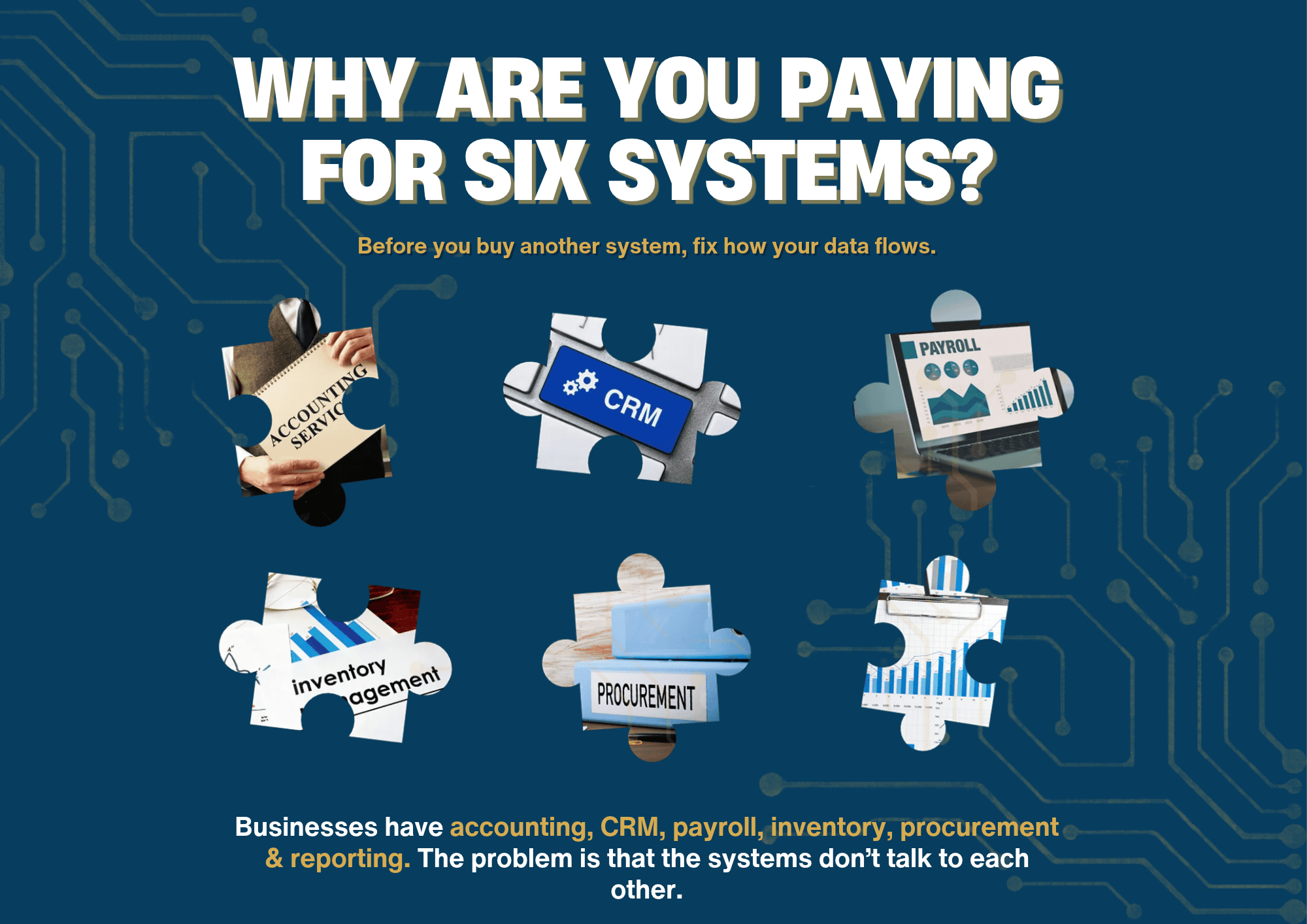
It also makes growth more expensive than it looks. Revenue goes up, but the people, systems and working capital needed to support it can’t keep pace.
What it looks like in practice
Five questions will tell you a lot about whether your infrastructure has kept up:
- Which processes now take far more effort than they should? Look at month-end tasks, reconciliations and approvals that need more people or more days than they did two years ago.
- Has headcount grown just to keep up with volume? Compare the growth in transactions with the growth in your finance and admin team over the same period.
- What would fail if volumes doubled? Check invoicing, payroll, collections and stock for steps already running at the limit of one person or one spreadsheet.
- Where is management flying blind? Note any figure that only arrives weeks after month-end, or only after someone has rebuilt it by hand.
- What still depends on the founder or one senior person? List the decisions, approvals and fixes that stop when that person is on leave. (If the list includes “anything to do with the bank”, you’re not alone.)
Symptom or cause?
It helps to separate the two. A late management pack looks like a reporting problem. But the cause often sits further upstream: late invoices, messy customer and supplier records, an unreconciled sub-ledger, or an approval waiting in someone’s inbox.
In the same way, an overworked team might really need more people. Or it might be spending most of its time working around a process that no longer fits the size of the business. The right fix depends on which one it is.
How to fix it
- Map how the business actually runs, end to end. People, processes, systems, controls, data and reporting.
- Measure the friction. Count the manual touches, how long each step takes, how much gets redone, and how much depends on specific people.
- Separate real capacity problems from self-made work. Some workload is genuine growth. Some only exists because of clunky processes or systems that don’t talk to each other.
- Focus on the few issues that will get much worse at your next stage of growth. You can’t fix everything at once, and you don’t need to.
- Build a 12 to 18 month roadmap. Give each item an owner, an investment decision and an outcome you can measure.
Order matters. Map and measure before you buy anything. Standardise a process before you automate it, and agree who owns it before you build a dashboard on top of it. If you do need new software, go into selection with written requirements and a clear target process. Don’t expect the vendor to design your business for you.
What good looks like
In a well-run business of this size, everyone knows which system holds each type of data, who owns each process and which controls actually matter. Routine work is handled by the system, and exceptions go to people with the right skills. Management can trace any important number back to where it came from.
Most importantly, volumes can grow without the workload growing at the same rate. The senior team spends its time on decisions, not repairs.
A practical test: follow one invoice
The quickest way to see whether your infrastructure has kept up is to follow a single transaction from start to finish. Invoice to cash works well, because nearly every business has it:
- Order or contract
- Invoice
- Delivery or service confirmation
- Payment received
- Cash allocated
- Reconciliation and VAT
At each step, ask who does the work, which system or spreadsheet holds the data, whether it gets captured again somewhere else, and what happens when something goes wrong. Count the hand-offs, spreadsheets, manual entries, approvals and corrections along the way.
Then ask three questions. What would happen if volume doubled? What if one key person was away? What if you needed the answer tomorrow instead of at month-end? Wherever the answer makes you wince is usually where your next investment belongs.
Common mistakes
- Hiring to absorb volume before checking whether that volume is really rework or re-capturing.
- Buying a new ERP or accounting system to fix a process problem. The problem simply moves into the new system with you.
- Treating the finance team’s heroics as proof that things are working. Late nights at month-end are a warning sign, not a success story.
- Writing a roadmap without owners, budgets and measures. It stays a nice document instead of becoming real change.
The South African compliance angle
Weak infrastructure really shows itself when fixed SARS dates arrive. Each of these depends on a ledger that is accurate and up to date:
| Obligation | What’s required |
| EMP201 (PAYE, UIF and SDL) | Declaration and payment by the 7th of the following month, or the last business day before it if the 7th falls on a weekend or public holiday |
| Provisional tax (companies) | First payment within six months of the start of the year of assessment, second payment at the end of it |
| Record keeping | Supporting records kept for at least five years after the return or data is submitted |
If any of these depends on one person pulling late nights to get the numbers right, that process is under more pressure than it looks.
Frequently asked questions
At what size do these problems usually appear? There’s no fixed revenue threshold. They tend to surface when a business adds a second entity or branch, when the finance team grows beyond a handful of people, or when management starts asking for information the original systems were never set up to produce. Complexity matters more than turnover, which is why two businesses of the same size can be in very different positions.
Should we fix our processes first or buy new software? In almost every case, fix the process first. Software follows the process you give it, so a poorly designed process becomes a poorly designed system. Once the process is clear and owned, you can judge whether your current tools can support it or whether you really need something new.
Where do we start? With one high-volume process, like invoice to cash. Map it from start to finish, and the manual touches, delays and dependencies you find will show you where to focus.
Talk to us
If you’d like an independent view of where your finance function will struggle at the next stage of growth, speak to the PGCO team.
Sources: SARS employer and EMP201 guidance; Tax Administration Act 28 of 2011, section 29 (record keeping); provisional tax timing as summarised in BDO’s Tax Guide 2025 and by Forvis Mazars South Africa.